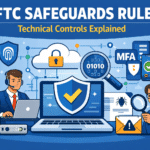
The FTC Safeguards Rule requires covered businesses to maintain a written information security program that protects customer financial information through clear ownership, a written risk assessment, risk-based safeguards, regular testing/monitoring, vendor oversight, and leadership reporting. It’s not a “buy tools and you’re compliant” rule—regulators generally look for a repeatable program you can explain and evidence. The Rule also includes a breach reporting requirement to the FTC for certain incidents affecting 500+ consumers, effective May 13, 2024. Some smaller organizations (under 5,000 consumers) are exempt from a few specific requirements, but they still must protect customer information appropriately.
Sources: https://www.ecfr.gov/current/title-16/chapter-I/subchapter-C/part-314/section-314.4 and https://www.ecfr.gov/current/title-16/chapter-I/subchapter-C/part-314 (see §§ 314.4, 314.5, 314.6)
2) Who This Is For
This is for:
- Non-technical business owners, partners, and executives who handle (or oversee teams that handle) customer financial information
- Leaders who want a plain-English view of what the Rule expects so they can staff, budget, and verify the work
This is not for:
- Technical implementers looking for step-by-step configuration instructions
- Businesses trying to determine legal coverage with certainty from a blog post (coverage can be nuanced—confirm with counsel if you’re unsure)
3) What This Is (Plain English Explanation)
The FTC Safeguards Rule is a federal requirement for certain businesses the FTC treats as “financial institutions” under GLBA (Gramm–Leach–Bliley Act). It requires you to develop, implement, and maintain reasonable administrative, technical, and physical safeguards to protect customer information.
In practice, the Rule expects you to run security like a business function:
- Someone is accountable
- Risks are identified and documented
- Safeguards are implemented to reduce those risks
- Safeguards are tested and monitored over time
- Vendors are managed
- The program is updated as the business changes
- Leadership receives regular reporting
4) Why This Matters (Regulatory + Business Risk)
Regulators care because customer financial information is a high-value target and many incidents come from predictable weaknesses: weak access control, missing multi-factor authentication (MFA), unencrypted data, unmanaged vendors, and security programs that exist only “informally.”
From a business perspective, the biggest risk often isn’t just a cyber event—it’s discovering (during a client review, insurer questionnaire, lender diligence, or regulatory inquiry) that you can’t produce basic evidence: a current written program, a written risk assessment, testing results, vendor oversight, and leadership reporting.
This is less about perfection and more about maintaining a defensible, documented, risk-based program.
5) Detailed Plain-English Breakdown (Numbered Requirements)
Important scope note: The Rule is “risk-based.” The exact safeguards and depth of documentation should be appropriate to your size, complexity, and the sensitivity of the information you handle. Also note the small-institution exception in 16 CFR § 314.6 (covered below).
Requirement 1: Designate a “Qualified Individual” (16 CFR § 314.4(a))
You must name a responsible person (“Qualified Individual”) to oversee and enforce the information security program. This can be an employee, an affiliate, or a service provider—but if you outsource the role, your business still remains responsible.
Common failure: “IT owns security” without a named accountable owner and leadership oversight.
What good looks like: A named owner with authority, clear reporting lines, and a schedule for leadership updates.
Requirement 2: Conduct and document a written risk assessment (16 CFR § 314.4(b))
Your program must be based on a written risk assessment that:
- Identifies reasonably foreseeable risks (internal and external)
- Evaluates safeguards currently in place
- Defines criteria for evaluating and categorizing risks
- Describes how you will mitigate or accept risks
Common failure: A one-time “checkbox” assessment with no remediation owners, timelines, or updates.
What good looks like: A living risk assessment tied to your real environment (systems, data flows, vendors), with clear decisions and periodic updates.
Requirement 3: Design and implement safeguards to control the risks (16 CFR § 314.4(c))
This is the heart of the Rule: implement controls that reduce the risks identified in your assessment. The regulation calls out specific safeguard areas, including:
3.1 Access controls (16 CFR § 314.4(c)(1))
Limit access to customer information to authorized users and only what they need.
- Common failure: Shared accounts, excessive admin rights, former staff still enabled
- Good looks like: Role-based access, offboarding, periodic access reviews
3.2 Inventory and manage “what matters” (16 CFR § 314.4(c)(2))
Identify and manage data, people, devices, systems, and facilities that support business objectives—based on risk.
- Common failure: No clear list of systems or where customer information lives
- Good looks like: A practical inventory (not perfect) that’s updated as things change
3.3 Encryption in transit and at rest (16 CFR § 314.4(c)(3))
Encrypt customer information both in transit and at rest. If encryption is infeasible in a specific case, you need effective compensating controls reviewed and approved by the Qualified Individual.
- Common failure: Sensitive files stored or transmitted without encryption
- Good looks like: Encryption standards and documented exceptions (rare and justified)
3.4 Application security (16 CFR § 314.4(c)(4))
Adopt secure development practices for in-house apps and evaluate/testing for external apps that access/store/transmit customer information.
- Common failure: No review of the security impact of new apps or integrations
- Good looks like: A repeatable evaluation step before adopting or changing systems
3.5 Multi-factor authentication (MFA) (16 CFR § 314.4(c)(5))
Implement MFA for any individual accessing any information system, unless the Qualified Individual approves an equivalent (or more secure) alternative in writing.
- Common failure: MFA only for email, but not admin portals, remote access, or core apps
- Good looks like: MFA across key systems with documented exceptions
3.6 Secure disposal + data retention minimization (16 CFR § 314.4(c)(6))
Develop and maintain procedures to securely dispose of customer information no later than two years after the last date it was used to provide a product/service—unless a legitimate business need, legal requirement, or technical infeasibility applies. Also periodically review retention to minimize unnecessary data.
- Common failure: Keeping old customer data indefinitely “just in case”
- Good looks like: A retention/disposal policy that matches legal/business needs and is followed
3.7 Change management (16 CFR § 314.4(c)(7))
Adopt procedures to manage changes so security doesn’t degrade quietly over time.
- Common failure: Major system changes with no security review
- Good looks like: Lightweight review + validation for material changes
3.8 Logging and monitoring of authorized user activity (16 CFR § 314.4(c)(8))
Implement controls to monitor/log authorized user activity and detect unauthorized access/use or tampering.
- Common failure: Logs exist but nobody reviews them or acts on them
- Good looks like: Defined alerting/review responsibilities and escalation paths
Requirement 4: Regularly test or monitor safeguards (16 CFR § 314.4(d))
You must regularly test or monitor key controls, systems, and procedures—including the ability to detect attacks or intrusions.
The Rule states this includes either:
- Continuous monitoring, or
- Periodic penetration testing and vulnerability assessments if you don’t have effective continuous monitoring
If you don’t have effective continuous monitoring, the Rule specifies:
- Annual penetration testing (based on relevant identified risks), and
- Vulnerability assessments at least every six months, and also after material changes or circumstances that could materially impact the program
Common failure: Testing is ad hoc and findings aren’t tracked through remediation and re-test.
What good looks like: A testing cadence, documented results, tracked remediation, and verification.
Requirement 5: Ensure personnel can carry out the program (16 CFR § 314.4(e))
You must implement policies/procedures so personnel can enact the program, including:
- Security awareness training is updated as needed based on risks
- Qualified security personnel (internal or service provider) sufficient to manage risk
- Ongoing updates/training for security staff
- Steps to keep key security staff current on threats and countermeasures
Common failure: “Annual training” that isn’t tracked, updated, or tied to real risks.
What good looks like: Training with completion records, role-appropriate coverage, and refreshers aligned to risk.
Requirement 6: Oversee service providers (vendor management) (16 CFR § 314.4(f))
You must:
- Take reasonable steps to select/retain vendors capable of safeguarding customer information
- Require safeguards by contract
- Periodically assess vendors based on the risk they present and the adequacy of their safeguards
Common failure: Assuming a vendor is secure because they’re well-known, without contracts/review evidence.
What good looks like: A vendor list, risk tiering, contract requirements, and periodic reviews scaled to vendor criticality.
Requirement 7: Evaluate and adjust the program over time (16 CFR § 314.4(g))
You must evaluate and adjust your program in light of:
- Testing/monitoring results
- Material changes to operations/business arrangements
- Risk assessment results
- Other circumstances that may materially impact the program
Common failure: Business changes, but the security program doesn’t.
What good looks like: Defined “update triggers” and a regular review cycle.
Requirement 8: Establish a written incident response plan (16 CFR § 314.4(h))
You must maintain a written incident response plan for security events materially affecting customer information. The Rule expects it to cover:
- Goals
- Internal response processes
- Roles and decision authority
- External/internal communications
- Remediation requirements
- Documentation/reporting
- Post-incident evaluation and revision
Common failure: A “plan” that’s just a contact list.
What good looks like: A plan your team can execute under stress, including documentation expectations and decision paths.
Requirement 9: Provide a written annual report to leadership (16 CFR § 314.4(i))
Your Qualified Individual must report in writing, at least annually, to the board (or equivalent). If you have no board, the report goes to a senior officer responsible for the program. The report must cover:
- Overall status of the program and compliance
- Material matters (risk decisions, vendor arrangements, testing results, security events/violations, management response, recommended changes)
Common failure: “We’re fine” verbal updates without a written record.
What good looks like: A short executive report backed by evidence and a prioritized improvement plan.
Requirement 10: Notify the FTC of certain breach events (16 CFR § 314.4(j); effective May 13, 2024)
If you discover a “notification event” involving customer information of at least 500 consumers, you must notify the FTC as soon as possible and no later than 30 days after discovery. Notification is electronic via an FTC form and includes required details (types of information, timing, number affected, general description, and certain law enforcement delay information, if applicable).
Common failure: Confusing incident response with regulatory reporting obligations.
What good looks like: Your incident response plan includes a decision path for whether FTC notification is required and who owns the timeline and documentation.
The “Under 5,000 Consumers” Exception (16 CFR § 314.6)
If your organization maintains customer information concerning fewer than 5,000 consumers, the Rule states that certain provisions do not apply:
- § 314.4(b)(1) (part of the written risk assessment requirements)
- § 314.4(d)(2) (certain monitoring/testing specifics)
- § 314.4(h) (written incident response plan requirement)
- § 314.4(i) (annual written report requirement)
This exception does not remove the expectation to protect customer information—it only removes some prescriptive requirements for smaller institutions.
6) Common Mistakes & Misconceptions
- “We bought tools, so we’re compliant.” Tools can support compliance, but the Rule expects a managed program: ownership, documentation, testing, oversight, and continuous improvement.
- “Our IT provider has it covered, so it’s not on us.” You can outsource tasks, but not accountability.
- “Risk assessment is paperwork.” It’s the foundation that makes your control decisions defensible and prioritized.
- “We’re small, so none of this matters.” Even if some provisions don’t apply under § 314.6, you’re still expected to safeguard customer information appropriately.
- “Vendor security is the vendor’s problem.” Vendor oversight is explicitly part of the program.
7) High-Level Implementation Overview (People / Process / Technology)
People
- Name the Qualified Individual and define authority
- Assign owners for vendor oversight, incident response, and reporting
- Train and verify completion
Process
- Maintain a written program + written risk assessment
- Set review cadences and change triggers
- Track testing findings through remediation and re-testing
- Maintain vendor selection, contract requirements, and periodic reviews
Technology
- Enforce MFA and strong access controls
- Encrypt customer information where required and document exceptions
- Implement monitoring/logging and a testing approach appropriate to your risk profile
8) How Office Heroes Supports This
Office Heroes supports Safeguards Rule readiness by helping businesses operationalize a documented, maintained security program—the part many small teams struggle to keep consistent over time.
- Guardian can support foundational controls and consistent operations for smaller teams.
- Titan often fits organizations that need stronger structure, visibility, and risk management as they grow.
- Overwatch aligns with ongoing compliance risk management—keeping risk work, documentation, evidence, and leadership-ready reporting organized and current.
(Office Heroes can support compliance efforts, but regulatory responsibility remains with the business.)
9) Related Resources & Internal Links
- Parent Hub: FTC Safeguards Rule Compliance Guide
- WISP Breakdown: Security Reporting & Compliance
- Risk Assessment Deep Guide: Cybersecurity Risk Assessments for Business Growth
- Overwatch Service Page: Compliance Risk Management
10) When to Get Help
Consider bringing in expert help if:
- You can’t produce a written program and a written risk assessment that match your real systems and workflows
- You don’t have a true “owner” (Qualified Individual) with authority and leadership visibility
- Testing/monitoring is inconsistent, undocumented, or findings aren’t remediated and re-tested
- Vendor oversight is informal or not evidenced (contracts, reviews, risk tiering)
- Your incident response approach is unclear, untested, or lacks a decision-making structure for notification obligations
Start with one question: Could you produce your written program and risk assessment tomorrow if asked?
If the answer is “no” or “I’m not sure,” let’s talk. We’ll help you figure out what’s actually required for your business and what a realistic path to compliance looks like.
Schedule a 30-Minute Conversation

Peter Zendzian is the Founder & Chief Cybersecurity Strategist at Office Heroes, a cybersecurity-focused Managed IT Service Provider helping CPA firms, law firms, credit unions, defense contractors, and small regulated businesses stay secure, compliant, and audit-ready.
Peter served more than 20 years in the U.S. Navy, retiring as a Chief Petty Officer after leading secure communications, cybersecurity operations, and technology teams across joint military environments. His background in classified systems, compliance, risk management, and operational security directly shapes Office Heroes’ modern, practical approach to protecting small businesses.
He is the co-author of two bestselling cybersecurity books:
Your Business Must Have a Cybersecurity Risk Assessment
Cybersecurity Essentials for Small Businesses
Peter is a trusted advisor to business owners and a subject matter expert in:
FTC Safeguards Rule compliance
GLBA compliance
NIST SP 800-171
CMMC Level 2 readiness
Microsoft 365 and Azure security
Endpoint protection, EDR, and vulnerability management
Data protection, disaster recovery, and cloud resilience
Secure remote access and Azure Virtual Desktop
Small business workflow automation
Certifications & Recognition
Retired U.S. Navy Chief Petty Officer (E-7)
DoD Cyber & Communications Leadership Training
20+ years managing classified systems and secure communications
Co-author of two bestselling cybersecurity books
Expert in FTC Safeguards, GLBA, NIST SP 800-171, and CMMC Level 2
Microsoft 365 and Azure security practitioner
Specialist in data protection, disaster recovery, and ransomware defense
Peter’s mission is simple: to make world-class cybersecurity, compliance, and IT support accessible to small businesses that don’t have internal IT or security teams — giving them the protection, clarity, and confidence they deserve.
- Peter Zendzian

- Peter Zendzian
- Peter Zendzian

- Peter Zendzian